Kubernetes Operator Study Journey
1. Try using existing operators
- prometheus-operator
- postgres-operator
- strimzi
- argocd: appcontroller.go
- grafana-operator
- mysql-operator
- terraform-k8s
And more
2. Understand what is Kubernetes operator.

- Kubernetes Controller components.
- How Kubernetes Controller works.
- Custom Resource.
Kubernetes Operator
A Kubernetes operator is an application-specific controller that extends the functionality of the Kubernetes API to create, configure, and manage instances of complex applications on behalf of a Kubernetes user.
From What is a Kubernetes operator?
Operators are software extensions to Kubernetes that make use of custom resources to manage applications and their components. Operators follow Kubernetes principles, notably the control loop.
From https://kubernetes.io/docs/concepts/extend-kubernetes/operator/
An Operator is like an automated Site Reliability Engineer for its application.
From Kubernetes Operators ~ Automating the Container Orchestration Platform ~
Operator vs. Controller
- Controller (custom controller): a component that manages custom resources by running a control loop (reconciliation loop).
- Operator: a CRD and custom controller that automate management of specific software, such as an etcd or MySQL operator.
Translated from A Practical Introduction to Kubernetes Custom Controllers
- Controllers can act on core resources such as deployments or services, which are typically part of the Kubernetes controller manager in the control plane, or can watch and manipulate user-defined custom resources.
- Operators are controllers that encode some operational knowledge, such as application lifecycle management, along with the custom resources defined in Chapter 4.
- A controller is a loop that reads desired state ("spec), observed cluster state (others' "status"), and external state, and the reconciles cluster state and external state with the desired state, writing any observations down (to our own "status").
- All of Kubernetes functions on this model.
- An operator is a controller that encodes human operational knowledge: how do I run and manage a specific piece of complex software.
- All operators are controllers, but not all controllers are operators.
From Tutorial: Zero to Operator in 90 Minutes! - Solly Ross, Google (YouTube)
For more detail: - CNCF Operator White Paper - Final Version - CNCF White Paper
3. Create a sample operator following a tutorial
There are several ways to create an operator. You can try any of them:
- operator-sdk
- kubebuilder
- metacontroller
- KUDO (Kubernetes Universal Declarative Operator)
- Learn Kubebuilder by Building
You can also reference example controllers:
- Sample Controller
- Istio Example Controller
- Foo Controller with Kubebuilder
- Memcached Operator with Operator SDK
4. Understand more detail about each component
The walkthroughs and diagrams target client-go v0.37.1 and controller-runtime v0.25.1 from go.mod. They include implementation structure, construction paths, and runnable examples.
Simplified:

Detailed:

More Detailed:
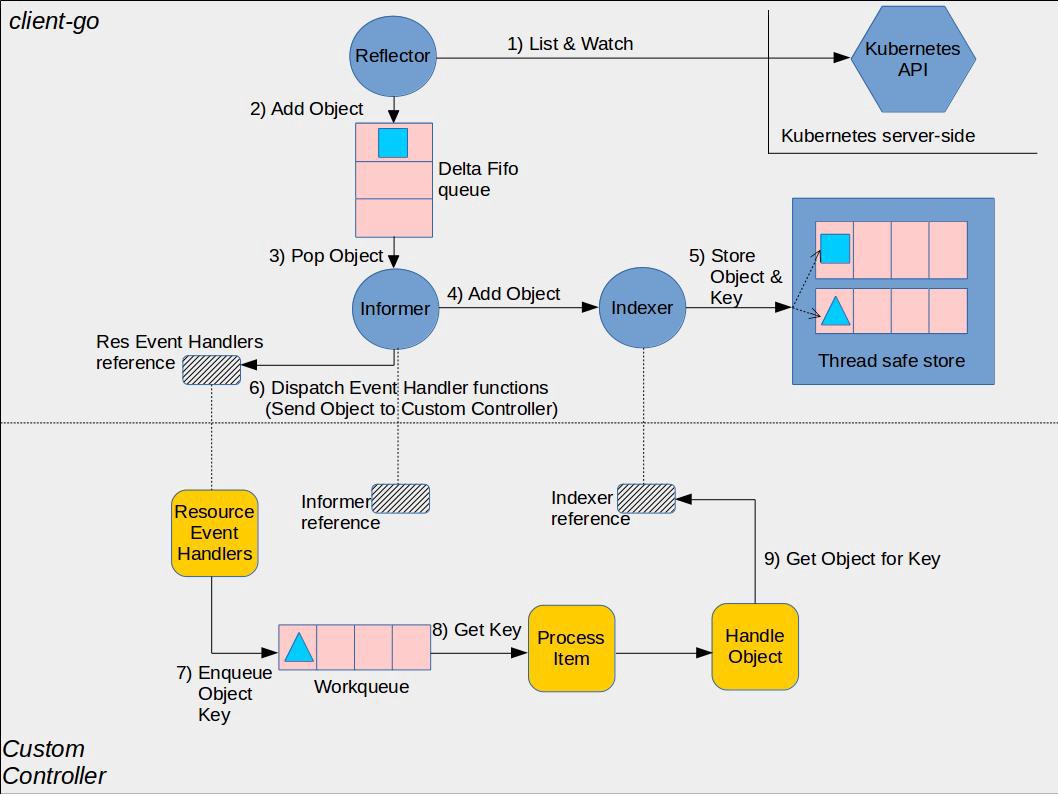

- client-go:
- clientset is a client for the built-in API resources.
- informer: watch the changes of objects and reflect the changes to the in-memory-cache.
- factory:
informers.NewSharedInformerFactory - watcher
- lister
- indexer
- event handler
- reflector
- factory:
- lister: Get data from in-memory cache.
- indexer: in-memory cache
- workqueue: A queue to store items that the controller will process.
- code-generator:
- Generate codes for clientset for a custom resource.
- apimachinery:
- Scheme: connects Kubernetes API and Go Types, API version conversion
- controller-runtime
Reference:
- https://adevjoe.com/post/client-go-informer/
- https://www.huweihuang.com/kubernetes-notes/code-analysis/kube-controller-manager/sharedIndexInformer.html
5. Create your own operator
After creating a sample operator, you should have deeper understanding of Kubernetes operator. Now you can think about what kind of problem that you want to resolve by utilizing operator pattern.
To clarify a problem to resolve with a new operator, you can reference existing operators:
| operator | role | language |
|---|---|---|
| prometheus-operator | Manage Prometheus, Alertmanager and their configuration | Golang |
| mysql-operator | Manage MySQL cluster | Python |
| postgres-operator | Manage PostgreSQL cluster (version upgrade, live volume resize, ...) | Golang |
| strimzi-kafka-operator | Manage Kafka cluster, user, and topic | Java |
| ... | ... | ... |
Considerations:
- Finalizer
- docs: Owners and Dependents: example
- Reconciliation Loop
- [operator-sdk] Based on the return value of Reconcile() the reconcile Request may be requeued and the loop may be triggered again: (Building a Go-based Memcached Operator using the Operator SDK)
// Reconcile successful - don't requeue return reconcile.Result{}, nil // Reconcile failed due to error - requeue return reconcile.Result{}, err // Reconcile again after a deliberate delay return reconcile.Result{RequeueAfter: time.Minute}, nil - https://github.com/operator-framework/operator-sdk/issues/4209#issuecomment-729916367
- How can I have separate logic for Create, Update, and Delete events? When reconciling an object can I access its previous state? -> You should not have separate logic. Instead design your reconciler to be idempotent.
- [operator-sdk] Based on the return value of Reconcile() the reconcile Request may be requeued and the loop may be triggered again: (Building a Go-based Memcached Operator using the Operator SDK)
- Testing
- KUbernetes Testing TooL (kuttl): https://kuttl.dev/ KUTTL is built to support some kubernetes integration test scenarios and is most valuable as an end-to-end (e2e) test harness.
- Ginkgo (A Golang BDD Testing Framework): https://onsi.github.io/ginkgo/
- Gomega (Ginkgo's preferred matcher library): https://onsi.github.io/gomega/
- kubetest2: https://github.com/kubernetes-sigs/kubetest2: Kubetest2 is the framework for launching and running end-to-end tests on Kubernetes. It is intended to be the next significant iteration of kubetest.
- Managing Errors
- https://cloud.redhat.com/blog/kubernetes-operators-best-practices
- Return the error in the status of the object.
- Generate an event describing the error.
-
Webhook
- Admission Webhook
- two types:
- Mutating Webhook: Make some modifications for a request. e.g. set default value. (Defined with
MutatingAdmissionConfiguration) - Validating Webhook: Validate a request. (Defined by
ValidatingAdmissionConfiguration)
- Mutating Webhook: Make some modifications for a request. e.g. set default value. (Defined with
- Request:
AdmissionReview - Response:
AdmissionReviewwithresponse.allowedboolean field.
- two types:
- Conversion Webhook
- hub & spoke
- isConvertible: need to have Hub & all non-Hub types must be able to convert to/from Hub
- request & response: ConversionReview

- Admission Webhook
6. Tools
- https://pkg.go.dev/sigs.k8s.io/controller-runtime/pkg/controller/controllerutil
- https://github.com/spf13/cobra: a library for creating powerful modern CLI applications & a program to generate applications and command files.
- Cobra is used in many Go projects such as Kubernetes, Hugo, and Github CLI to name a few. This list contains a more extensive list of projects using Cobra.
7. Study Golang for better code quality
- golang-standanrds/project-layout
- Learn Go with tests
- The Current State of Go and Dependency Injection
- Go Blog
- Gopher Reading List
- Type Embedding
8. Other Topics
- Write Kubernetes Operator in other languages
- kopf for Python
- fabric8io/kubernetes-client for Java
- java-operator-sdk/java-operator-sdk Build Kubernetes Operators in Java Without Hassle
- Optimistic Concurrency Control
9. Keep learning
10. Example test inventory
The runnable examples are intentionally split between unit tests and Kubernetes-backed tests:
| Example | Live API server | Coverage |
|---|---|---|
client-go/clientset |
Yes | E2E target (API access) |
client-go/deltafifo |
No | Unit/fake objects |
client-go/indexer |
No | Unit/in-memory indexer |
client-go/informer |
Yes | E2E target; cache sync and Pod add/update/delete |
client-go/lister |
No | Unit/fake indexer |
client-go/listerwatcher |
Yes | E2E target; list/watch delivery |
client-go/reflector |
No runnable binary | Covered through informer/list-watch concepts |
client-go/workqueue |
No runnable binary | Unit-level concept |
controller-runtime/cache |
Yes | E2E target; cache sync and read |
controller-runtime/example-controller |
Yes | E2E target; ReplicaSet pod-count reconciliation |
controller-runtime/manager |
Yes | E2E target; manager startup and watches |
controller-runtime/reconciler |
No | Unit test/example |
controller-runtime/source |
Yes, with its example CRD | Documented live-cluster dependency; no remote CRD is applied by CI |
controller-runtime/log |
No | Process/unit example |
controller-runtime/webhook |
Not by the standalone example | Unit/process example; it does not register an API-server webhook |
The live-cluster suites are selected independently as client-go and controller-runtime targets. CI creates a temporary kind cluster for each selected target. Developers can run either target against an existing cluster by setting KUBECONFIG; the runner removes only resources created by the test and never deletes a developer-provided cluster.
- 47 Things To Become a Kubernetes Expert
- Kubernetes API Basics - Resources, Kinds, and Objects
- Kubernetes API Conventions
- How To Call Kubernetes API using Simple HTTP Client
- How To Call Kubernetes API using Go - Types and Common Machinery
- How To Extend Kubernetes API - Kubernetes vs. Django
- Manage Custom Resources with client-go Without Generating a Client
- kubebuilder vs operator-sdk (2019-04-10)
- client-go Informer Source Analysis
- Operator Best Practices